Choosing the best Outdoor WPC Decking in 2026 means looking beyond color samples and product claims. A board that looks warm and even in a showroom may feel different under strong afternoon sun. The right choice depends on climate, drainage, foot traffic, budget, and the structure beneath the deck. Small details matter.
This guide compares practical features, including core composition, surface texture, slip resistance, fading, and expected maintenance. It also considers board dimensions, fastening systems, warranties, and the quality of installation guidance. These factors can affect how a deck performs after years of rain, heat, and everyday use. No single product is best for every home. A shaded balcony has different needs from a poolside patio, where water and frequent foot traffic are common.
Some specifications are easy to compare; real-world durability is harder to judge without consistent testing and clear warranty terms. That distinction deserves attention. A low-maintenance claim, for example, does not mean maintenance-free. Cleaning requirements and ventilation still matter. This overview offers a careful framework for weighing available options, while recognizing that product availability and performance vary by region. The aim is not to declare a universal winner, but to help readers identify decking that suits their site and expectations. A sample board outdoors can reveal more than a polished catalog image. It may also expose a weakness.
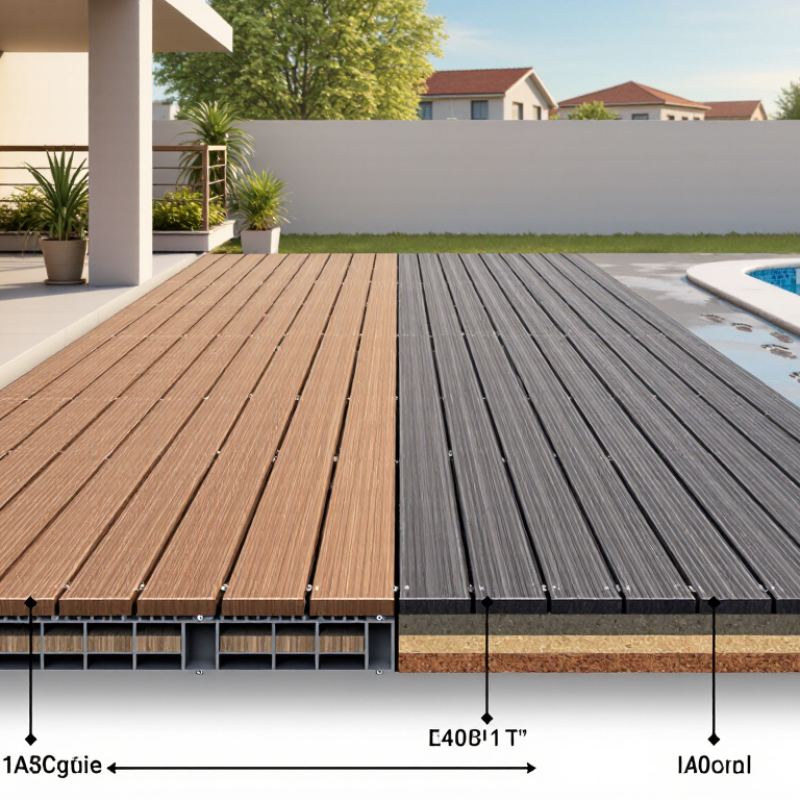
Outdoor WPC decking is made from wood fibers or fine wood flour blended with thermoplastic polymer. Common polymers include polyethylene and polypropylene, though formulations differ. Heat and pressure shape the mixture into boards, often through extrusion. Small amounts of pigment, UV stabilizers, and bonding additives may also be included. The exact recipe affects color, surface texture, and resistance to moisture. There is no single standard blend.
Board construction matters, too. Solid boards have a dense profile and substantial weight. Hollow boards contain internal channels, which reduce material use and make handling easier. Those channels can collect debris if ends are left exposed, so edge details deserve attention. The details matter. Some boards are capped with a thin protective polymer layer; others have an exposed composite surface. A cap may help resist stains, but it does not make a board immune to scratches or fading.
When comparing types, check the stated support spacing, fastening method, and expansion allowance. WPC can expand and contract with temperature changes, especially in direct sun. A dark board beside a warm patio wall may feel hot underfoot. Composition alone cannot identify the best choice. I would also question broad claims of “maintenance-free,” since cleaning and occasional inspection still matter. The product specification and installation conditions should guide the decision.
A representative wood–polymer composition of outdoor decking
Wood–plastic composite (WPC) decking combines wood fiber or flour with a polymer matrix and smaller amounts of additives. This chart shows an illustrative formulation, not a universal specification: actual proportions vary by product. Solid, hollow, and capped boards describe board construction or surface design, not a fixed material recipe.
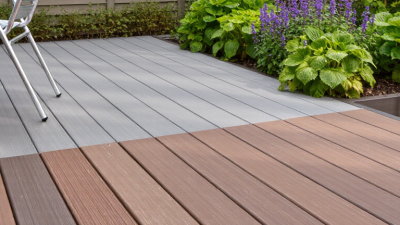
Capped WPC decking has a protective polymer layer over its composite core. That cap slows water absorption and helps resist surface stains, fading, and mildew. It is useful around damp garden beds or shaded patios where boards dry slowly. But capped does not mean waterproof. Water can still collect between boards or reach cut ends, so spacing and drainage matter.
Uncapped boards usually cost less, but their exposed surface can absorb more moisture. In persistently wet conditions, that may increase swelling, staining, or color variation. They often need closer attention: sweep away leaves, rinse off mud, and clean spills before they settle. Keep it simple. Harsh scrubbing can mark some surfaces.
The right choice depends on exposure and upkeep. For a sunny, well-drained deck, uncapped boards may be adequate if you accept more routine cleaning. For a damp site, capped boards generally offer an easier-care surface, though they still need washing and clear drainage gaps. One easy mistake is comparing only the board face. Check the edges, fastening instructions, and ventilation beneath the deck, too. Even a durable board can disappoint when trapped water has nowhere to go. I would not treat “low maintenance” as “no maintenance”; that distinction is easy to overlook.
ASTM D7032 offers a practical way to assess outdoor wood-plastic composite decking and guardrail performance. It establishes performance ratings for deck boards and guardrail systems; it does not name one product the “best.” Look for test documentation tied to the exact board profile, material formulation, and installation configuration. Similar-looking boards may not share the same rating. Details matter.
Check the report for the tested span and relevant structural performance, then compare those conditions with the planned joist spacing. For guardrails, confirm that the evaluated system matches the actual posts, rails, connections, and layout—not just one component. A railing can feel firm by hand and still need documented performance. On site, note where stairs, corners, or exposed edges change the setup. Not interchangeable. ASTM results also do not replace local building requirements or careful installation. I would want the report’s test scope and standard edition stated clearly; otherwise, it is hard to know what the rating really covers. Even good test data cannot erase poor drainage, neglected maintenance, or unsupported spans.
For the best outdoor WPC decking in 2026, start with the structure beneath it. The 2021 International Residential Code, Table R301.5, sets a 40-pound-per-square-foot live-load benchmark for decks. It also specifies a 200-pound concentrated load for guards, applied at any point along the top. These are separate checks. A deck’s surface boards do not, by themselves, prove that joists, posts, connections, and guards meet either benchmark. Check the code edition adopted locally; requirements and amendments can differ.
Ask for product-specific test documentation, not just a “strong” or “heavy-duty” claim. ASTM D7032 provides a testing and performance-rating framework for wood-plastic composite deck boards, stair treads, guards, and handrails. Compare the stated span limits and installation details with your actual framing plan. A damp morning, a crowded gathering, and a person leaning on the guard create different demands. Small details matter. Fastener spacing and unsupported board ends can change performance. I would still inspect the framing carefully; a compliant board cannot fix a weak connection. Cite the 2021 IRC, Section R301.5, and ASTM D7032 when reviewing specifications with your installer.
| Selection dimension | Benchmark or established fact | What it means when choosing WPC decking | What to verify |
|---|---|---|---|
| Deck live load | IRC Table R301.5 lists 40 psf for decks in the applicable code editions. | This is a design load for the deck structure, not a standalone load rating for a decking board. Joists, beams, connections, posts, and footings also matter. | Confirm the locally adopted IRC edition and amendments. Check that the framing design and board installation instructions work together. |
| Guard load | IRC Table R301.5 includes a 200-lb concentrated load for guards and handrails, applied in the specified direction at the top. | This is a guard-system design benchmark, not a strength rating for the deck surface board. Posts and their connections to the deck framing are critical. | Verify guard-post attachment details and applicable local requirements; do not rely on a decking board alone to support a guard. |
| Guard infill load | IRC Table R301.5 also specifies a 50-lb load over a 1-square-foot area for guard infill components, subject to the applicable edition. | This applies to components such as infill panels or balusters, not to the walking surface as a general board rating. | Check the adopted code, guard design, infill spacing, and product documentation. |
| Board span and framing spacing | There is no single joist-spacing limit that applies to every WPC board. Permitted spans depend on the specific product, installation pattern, and loading conditions. | A board that is not installed at its approved support spacing may flex excessively or fail, even when the overall deck framing is designed for the required load. | Use the board maker’s published span, fastening, end-support, and stair-installation instructions for the exact board profile. |
| Capped or uncapped surface | Capped WPC has a polymer-rich outer layer; uncapped WPC does not have that same protective cap. Formulations and performance vary by product. | A cap may provide added resistance to surface staining and moisture exposure, but it does not make a board maintenance-free or establish structural capacity. | Review product-specific cleaning guidance, stain and fade coverage, and limitations for standing water, heat, and surface damage. |
| Solid or hollow profile | Both profile types are used in composite decking; profile alone does not establish load capacity or durability. | Weight, edge finishing, fastening method, and allowable spans are product-specific. A lighter profile is not automatically the better choice for every deck. | Compare published technical data and installation requirements rather than judging by profile shape alone. |
| Slip performance when wet | The IRC load benchmarks above do not provide a universal wet-slip rating for WPC decking. | Surface texture, water, debris, footwear, and maintenance can affect traction. A textured appearance alone is not a measured slip rating. | Ask for relevant test data and the test method, especially for stairs, pool areas, and other frequently wet locations. |
| Product evaluation and documentation | ASTM D7032 covers performance ratings for wood-plastic composite decking and guardrail systems within its scope. | Relevant test reports or evaluation documents can help establish how a particular product was assessed; they do not replace code-compliant deck design. | Request current product-specific documentation and confirm acceptance with the local building department. |
Note: Code provisions vary by adopted edition and local amendments. The 40-psf deck load and 200-lb guard load are structural design benchmarks; they are not, by themselves, product ratings for WPC decking boards.
The best outdoor WPC decking in 2026 depends on climate, warranty terms, and the full installed price—not the board’s sticker price alone. In hot, sunny yards, ask for tested heat and color-fade performance; dark boards can become uncomfortable under bare feet. In wet or freeze-thaw climates, prioritize drainage, textured surfaces, and installation details that allow expansion. ASTM D7032 provides performance criteria for composite decking, but a standard is not a substitute for site-specific advice.
Read the warranty closely. Check whether it covers fading, stains, structural damage, and labor, and whether coverage changes when boards are installed near pools or coastal areas. The fine print matters. For a cost benchmark, Zonda’s 2024 Cost vs. Value report estimated an average U.S. composite-deck project at $24,206, with $16,498 in resale value. That is a modeled national average, not a quote for WPC boards or your property. Ask contractors to itemize framing, substructure, fasteners, stairs, and disposal; these can shift the installed total substantially.
Compare at least two written bids using the same deck size and scope. Request samples and inspect them outdoors at midday, when heat and glare are obvious. A low-cost board may look attractive on paper, yet the savings can disappear if the site needs extra framing or difficult access. Be candid about upkeep: even low-maintenance decking needs cleaning, and “maintenance-free” is rarely a useful promise.