As a leading plastics recycler and producer of green composite.
Leave Your Message

2026 Best Composite Cladding Types for Global Buyers?

Global buyers are entering 2026 with more Composite Cladding choices, but also greater technical responsibility. Panels may resemble timber, stone, or painted metal. Their performance can differ sharply behind the surface.

Grand View Research estimated the global composite materials market at about USD 96.7 billion in 2023. Its 2024–2030 analysis also indicates continued expansion, supported by construction and infrastructure demand. MarketsandMarkets similarly identifies lightweight construction materials as a growing application area. These reports do not measure every cladding system equally. Their categories overlap. That limitation matters.

Joseph Lstiburek, a respected building-science expert, offers a useful principle: “A wall is a system, not a collection of products.” Composite Cladding must therefore be judged beside the cavity, insulation, membranes, fasteners, and drainage path. A coastal project may need stronger corrosion resistance. A high-rise façade may require verified reaction-to-fire performance. A cold climate demands careful attention to thermal bridging and condensation.

Details decide outcomes.

This guide compares leading Composite Cladding types for international buyers in 2026. It considers fiber-reinforced polymer panels, wood-plastic composites, aluminum composite panels, mineral-filled boards, and newer recycled-content solutions. Product appearance is only one checkpoint. Buyers should examine tested fire classifications, wind-load data, water management, ultraviolet stability, warranty terms, repair access, and environmental documentation.

Not every “green” claim survives scrutiny. Regional standards also vary. A product suitable for a low-rise home may fail a commercial façade review. The strongest decision combines laboratory evidence, installer experience, local code verification, and realistic service conditions.

2026 Best Composite Cladding Types for Global Buyers?

Composite Cladding Materials and Core Technologies in 2026

2026 Best Composite Cladding Types for Global Buyers?

Composite Cladding Materials and Core Technologies in 2026

Composite cladding choices are becoming more technical in 2026. Wood-polymer composites provide a warm appearance, stable color, and practical moisture resistance. Mineral-filled polymer panels offer improved stiffness and lower thermal movement. Recycled PVC-based systems can reduce material waste when their formulation and recovery routes are verified. Each option has limits. A darker façade may absorb strong solar heat and expand noticeably.

Core technology now matters as much as the visible finish. Co-extruded protective layers can improve resistance to ultraviolet exposure, staining, and surface scratches. Internal ribs reduce panel weight without making installation fragile. Hidden mechanical clips support cleaner façades, but installers must allow movement around joints. Fire performance, wind loading, drainage, and fastener corrosion require documented testing for the project location. Local building requirements still decide suitability.

Tips: Request test reports, installation drawings, and batch consistency records. Compare water absorption after repeated wet-dry cycles. Check whether recycled content is independently verified. Ask how panels behave near corners and window openings. Small details often reveal bigger risks.

A practical sample review is worth the time. Touch the edges. Inspect the cut surface. Some panels look convincing online but feel brittle on site. I would also question perfect claims, because no composite material suits every climate. Coastal exposure, desert heat, freezing temperatures, and heavy rainfall demand different specifications. A careful buyer should treat design life as a tested expectation, not a marketing promise.

2026 Best Composite Cladding Types for Global Buyers

Indicative service-life ranges for major composite cladding technologies under proper design, installation, inspection, and maintenance conditions.

Data represents typical industry ranges rather than guaranteed performance. Actual durability depends on climate, UV exposure, moisture control, fire design, fixing systems, cleaning, and installation quality.

WPC: Wood-polymer composite with co-extruded weathering layers.
HPL: High-pressure thermoset laminate reinforced with cellulose fibers.
FRP: Glass-fiber-reinforced polymer matrix for lightweight strength.
ACP: Aluminum skins bonded to a fire-resistant mineral core.
Fiber cement: Cementitious matrix reinforced with cellulose or mineral fibers.

Key Composite Cladding Types and Their Structural Differences

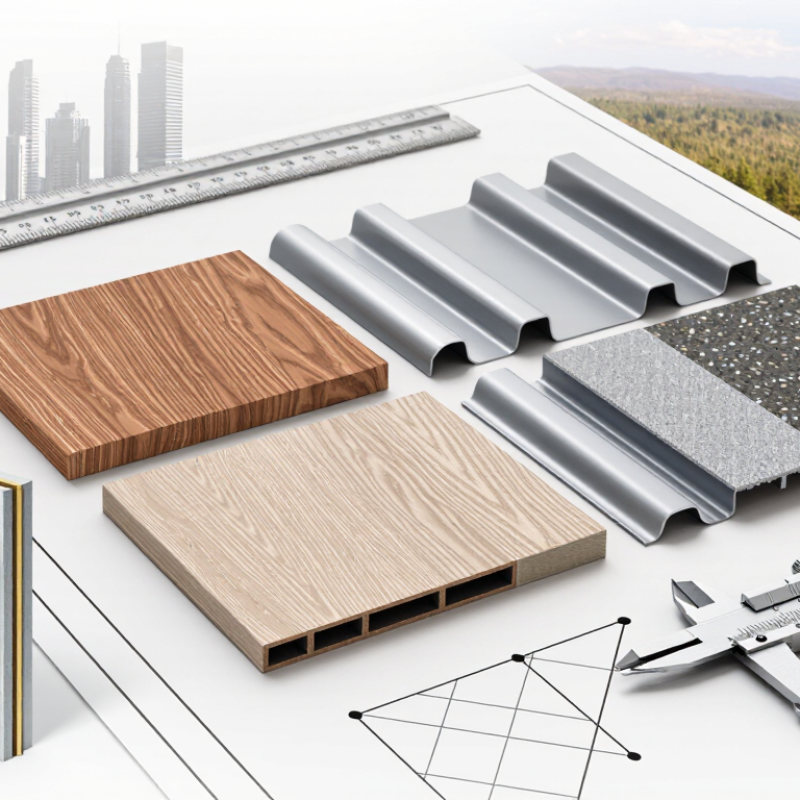
Composite cladding is not one material with several colors. Its internal structure determines performance, installation, and service life. For global buyers, the key question is not appearance alone. It is how the panel carries loads, sheds water, and handles movement. Three common types deserve close comparison: aluminum composite panels, fiber-reinforced polymer panels, and wood-plastic composite boards.

Aluminum composite panels use thin aluminum skins around a polymer or mineral core. The skins provide stiffness and a clean, flat surface. Core selection strongly affects fire behavior and temperature stability.

Fiber-reinforced polymer panels combine resin with glass or carbon fibers. Their directional reinforcement can provide high strength at low weight, especially in corrosive environments. However, drilled edges and poorly sealed joints may weaken long-term protection.

Wood-plastic composite boards contain wood fibers mixed with polymers. They are usually thicker and heavier than sheet panels. Their structure suits ventilated rainscreens and decorative façades, but moisture and thermal expansion require careful spacing.

Installation details often reveal the real difference. A lightweight aluminum panel may use cassette folds or concealed clips. A fiber-reinforced panel may need engineered brackets and controlled fastener spacing. Wood-plastic boards commonly rely on clips over a rigid subframe.

On site, small errors matter: uneven rails can telegraph through thin panels, while tight joints can buckle during hot weather. A common mistake is comparing only price per square meter. Buyers should review core composition, fire test data, impact resistance, coating durability, and local wind calculations. I would also question impressive laboratory values without project-specific fixing details. Real façades rarely fail in the brochure; they fail at joints, corners, and transitions.

How Global Buyers Compare Durability, Safety, and Appearance

For global buyers, composite cladding should be compared as a system, not as a sample board. In project reviews, I examine the core, surface layer, fasteners, joints, and drainage path. A panel may resist rain well, yet fail early when water remains behind poorly ventilated rails. Durability depends on UV exposure, freeze-thaw cycles, salt air, impact risk, and maintenance access. Ask for independently verified test data, not only marketing ratings. Check color retention, dimensional stability, and resistance to cracking after repeated temperature changes. Local climate matters more than a universal product ranking.

Safety requires equal attention. Request documented fire performance, smoke data, and installation limits for the complete assembly. A safer-looking panel can perform differently with insulation, membranes, cavities, or unapproved fixings. Confirm that test reports match the proposed thickness and mounting method. I also check edge details around windows, vents, and balconies, where small gaps can create serious weaknesses. Compliance should be confirmed with qualified local professionals and current building rules. Paperwork alone is not enough.

Appearance affects long-term value, but photographs can mislead. Compare full-size samples outdoors, where gloss, grain, and shadow lines are easier to judge. Dark finishes often show dust, scratches, and heat movement more clearly. Textured surfaces hide minor marks, but they may collect dirt. Color consistency between production batches deserves attention. I have seen attractive samples look flat after installation. That lesson still matters. Choose a finish that suits cleaning routines, nearby materials, and realistic maintenance budgets. The best comparison is honest, site-specific, and slightly cautious.

Regional Climate, Building Codes, and Installation Requirements

2026 Best Composite Cladding Types for Global Buyers?

Regional climate should guide composite cladding selection more than appearance. In humid coastal areas, choose panels with low water absorption and corrosion-resistant fixings. Wood-polymer composites can offer warmth, but poor ventilation may trap moisture behind them. That detail is often missed.

Cold regions need stable panels, insulated backing, and movement allowances for freeze-thaw cycles. In hot, sunny climates, check colour retention, thermal expansion, and surface temperature. Mineral-filled polymer panels may provide useful dimensional stability. Fiber-reinforced systems can suit exposed façades, but their weight may increase structural demands. Not every “durable” panel performs well in every climate.

Building codes vary by country, city, and building height. Verify fire classification, wind resistance, impact performance, and smoke requirements through current test reports. Never assess a panel alone; approval may depend on the complete wall assembly.

Installation also matters. Use the specified cavity depth, drainage paths, fastener spacing, and joint gaps. Local installers should understand substrate movement and flashing details. Small errors become expensive leaks.

I have seen attractive façades fail because the installer ignored corner ventilation. A pre-installation mock-up can reveal weak details before full construction.

Requirements change. Check them again.

Procurement Criteria for Selecting the Best Composite Cladding System

2026 Best Composite Cladding Types for Global Buyers?

Procurement begins with project evidence, not appearance. Compare WPC, mineral-filled polymer, and fiber-reinforced panels against exposure, fire, weight, and maintenance needs. Ask for verified fire-test reports, water absorption data, thermal movement values, and fixing-system calculations. A smooth sample can hide poor edge stability. Request full-size mock-ups. Inspect joints after rain, heat, and cleaning.

Regional compliance should guide selection. A system accepted in one market may fail another’s facade rules. Confirm test scope, production consistency, environmental declarations, and traceable batch records. Check wind-load calculations for the actual building height and fixing pattern. Do not rely only on brochure values. Independent laboratory evidence carries more weight. So does an installer’s documented experience with similar climates. Include replacement panels, color matching, and spare fasteners in the procurement plan.

Logistics can change the “best” choice. Review lead times, packaging, port handling, and local technical support before signing. Request a written warranty with exclusions clearly stated. Low-cost panels may demand frequent cleaning or costly subframe changes. That risk is easy to underestimate. I would score performance, compliance, service, and lifecycle cost separately. Yet the scoring model still needs judgment. Coastal salt, freeze-thaw cycles, and intense sunlight can expose assumptions quickly. Leave room for site testing and revise the specification when evidence disagrees.

2026 Best Composite Cladding Types for Global Buyers? - Procurement Criteria for Selecting the Best Composite Cladding System

Comparative procurement guide for commonly specified composite and engineered cladding systems. Values are typical industry ranges for preliminary selection; final performance must be verified through project-specific test reports, local building codes, exposure conditions, and the complete wall assembly.

Cladding Type Typical Composition Common Thickness Approx. Panel Mass Moisture and Dimensional Performance Fire Performance UV and Weathering Indicative Service-Life Target Key Procurement Checks Typical Best-Fit Applications
Wood-Plastic Composite (WPC) Wood fibre or flour combined with thermoplastic resin, stabilizers, pigments, and surface additives. 18–30 mm for boards; 8–20 mm for some profiled panels. Approximately 10–20 kg/m², depending on profile and density. Low water absorption compared with natural wood; thermal expansion and moisture movement require designed fixing gaps and ventilation. Highly formulation-dependent. Require a tested classification for the complete system under EN 13501-1 or a local equivalent. Good with UV stabilizers
Colour fading and surface weathering should be assessed through accelerated or natural exposure testing.
Approximately 20–30 years when correctly detailed and maintained. Check recycled-content consistency, density, slip or pull-out resistance of fixings, coefficient of thermal expansion, colour-change limits, drainage details, and batch-to-batch colour tolerance. Residential façades, balconies, screened façades, low- to mid-rise commercial buildings, and projects requiring a timber appearance with reduced routine painting.
High-Pressure Laminate (HPL) Compact Panels Multiple layers of kraft paper and decorative paper impregnated with thermosetting resin and compressed under high pressure. 6–12 mm for ventilated façade panels. Approximately 8–14 kg/m². Low water absorption and good dimensional stability; edge detailing and rear ventilation remain important. Can achieve strong fire performance in tested assemblies, but classification depends on thickness, substrate, joints, cavity barriers, and fixing method. Very good for exterior grades
Specify a façade-grade product with documented resistance to UV, moisture, and freeze–thaw exposure.
Approximately 30–40 years, subject to exposure and maintenance. Request EN 438 exterior-grade compliance or equivalent, reaction-to-fire reports, impact resistance, colour stability, panel flatness, subframe compatibility, and tested joint details. Ventilated rainscreens, schools, offices, healthcare facilities, transport buildings, and façades requiring a wide range of colours and textures.
Fiber-Cement Composite Panels Cementitious binder reinforced with cellulose or other mineral-compatible fibres, pigments, and performance additives. 8–12 mm for façade panels; thicker boards may be used for specific systems. Approximately 12–20 kg/m². Non-combustible mineral content and good moisture resistance; panels may experience moisture-related movement and must be detailed with open joints or approved sealants. Often strong
Many products are classified in high fire-performance groups, but the exact result depends on coatings, fixings, insulation, and the full wall build-up.
Good
Factory-applied finishes normally provide better colour consistency than field painting.
Approximately 30–50 years with suitable detailing and coating maintenance. Check density, water absorption, freeze–thaw testing, edge strength, impact performance, coating warranty, cutting dust controls, panel tolerances, and allowable fixing distances. Mid- and high-rise rainscreens, urban façades, fire-sensitive buildings, and projects prioritizing mineral-based appearance and durability.
Aluminum Composite Material (ACM) Two aluminum skins bonded to a polymer or mineral-filled core; available with different core formulations and coatings. 3–6 mm overall thickness; 4 mm is common for many façade applications. Approximately 5–8 kg/m². Very low water absorption; aluminum experiences thermal movement and requires allowance at joints, cassette folds, and fixing points. Core-dependent
Specify a mineral-filled or other code-compliant core where required. Never infer fire performance from the aluminum skins alone.
Good to very good
PVDF or equivalent high-performance coatings generally provide better long-term exterior colour retention than basic coatings.
Approximately 25–40 years, depending on coating, environment, and maintenance. Verify core type, reaction-to-fire classification, coating specification, coating thickness, bond integrity, panel flatness, cassette fabrication method, wind-load testing, and galvanic compatibility. Large-format commercial façades, feature bands, parapets, canopy soffits, column covers, and lightweight rainscreen systems.
Glass-Fiber-Reinforced Polymer (GFRP) Glass fibres embedded in a polymer matrix, commonly polyester, vinyl ester, or epoxy resin, with a weather-resistant gel coat or coating. 3–8 mm skins or molded panels; structural depth varies by profile. Approximately 4–12 kg/m², depending on reinforcement and geometry. Low water absorption and good corrosion resistance; resin selection, edge sealing, and fastener detailing are critical in wet or freeze–thaw climates. Formulation-dependent
Require project-specific smoke, flame, and fire-propagation evidence for the complete panel and support system.
Good when UV-stabilized
Inspect gloss retention, chalking, gel-coat thickness, and colour-change data for exposed façades.
Approximately 25–40 years with suitable resin, coating, and maintenance. Check resin type, fibre content, panel stiffness, creep, impact resistance, flame spread, smoke development, water absorption, repair method, and connection design. Curved façades, lightweight retrofit systems, corrosion-prone coastal or industrial sites, canopies, and geometrically complex envelopes.
Phenolic Resin Compact Panels Cellulose-based layers impregnated with thermosetting phenolic resin and compressed into dense compact panels. 6–12 mm for exterior façade use. Approximately 9–14 kg/m². Low water absorption and good stiffness; correct rear ventilation and clearance from standing water are required. Good in tested systems
Fire rating varies with panel grade, thickness, mounting, cavity, and insulation combination.
Good for exterior grades
Specify documented resistance to UV, humidity, thermal cycling, and freeze–thaw conditions.
Approximately 30–40 years, subject to exposure and maintenance. Request exterior-grade certification, reaction-to-fire data, impact resistance, panel tolerances, machining quality, concealed-fixing compatibility, and colour-stability evidence. Ventilated façades, educational buildings, sports facilities, retail façades, and projects needing compact panels with durable decorative surfaces.
Mineral-Filled Polymer Composite Panels Polymer binder combined with mineral fillers, pigments, fire modifiers, and reinforcement or backing layers. 4–12 mm, depending on panel construction and reinforcement. Approximately 7–16 kg/m². Generally low water absorption; dimensional movement, backing adhesion, and edge stability vary significantly by formulation. Must be verified by test
Mineral filler does not automatically make a polymer composite non-combustible or suitable for every building height.
Good with qualified coating
Specify colour-retention data for the intended solar and pollution exposure.
Approximately 25–40 years, depending on formulation and finish. Check mineral content, core chemistry, fire classification, smoke performance, delamination resistance, impact testing, thermal cycling, adhesive compatibility, and repairability. Lightweight rainscreens, renovation projects, façade accents, and applications requiring a balance between low mass, design flexibility, and improved fire performance.
Engineered Timber Composite Cladding Thermally modified or engineered wood fibres, veneers, or laminates combined with binders, protective coatings, or structural backing layers. 18–35 mm for boards and profiled systems; panel thickness varies by construction. Approximately 10–20 kg/m². Better consistency than many solid-wood boards, but still sensitive to moisture, coating condition, end-grain exposure, and ventilation. Coating and assembly-dependent
Fire-retardant treatment and full-system testing may be necessary for multi-storey applications.
Moderate to good
Expect periodic coating inspection and possible refinishing, particularly on highly exposed elevations.
Approximately 20–30 years, with regular inspection and finish maintenance. Verify certified timber content where required, moisture content, coating system, end sealing, fungal and insect resistance, fixing schedule, ventilation cavity, and maintenance cycle. Low- to mid-rise housing, hospitality, nature-sensitive developments, and façades seeking a natural timber appearance.